
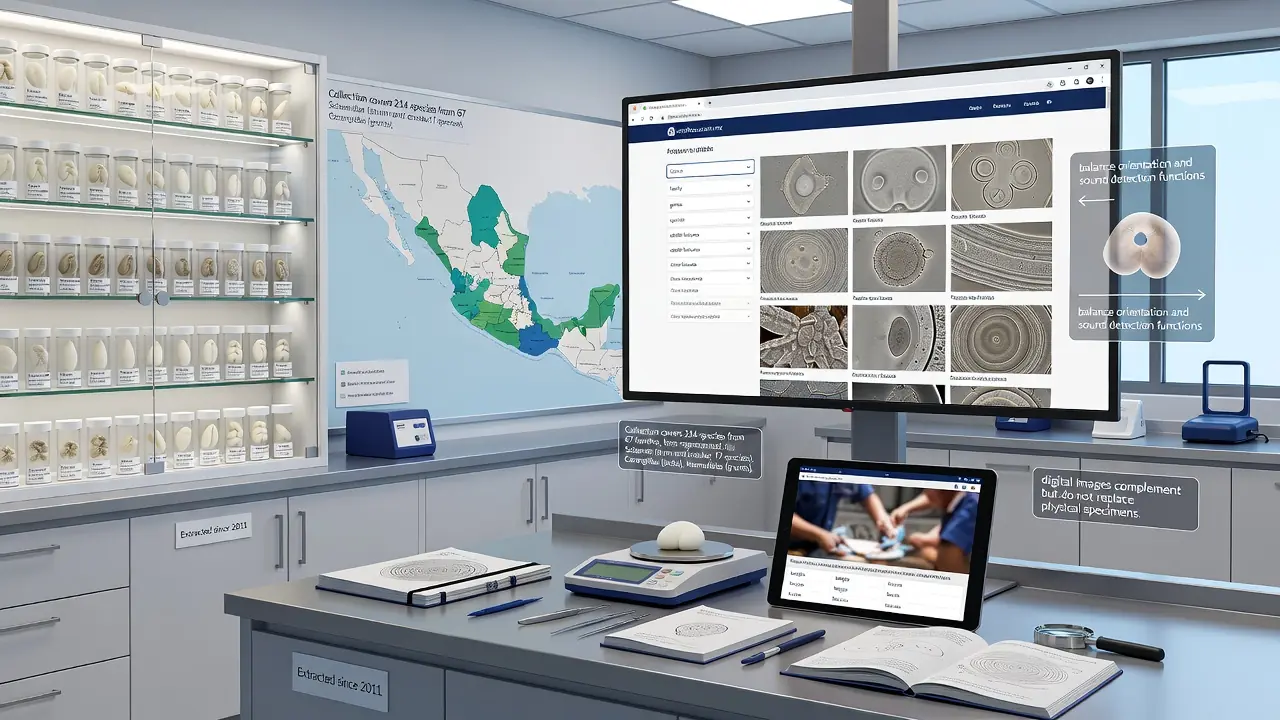
A Mexican research team has made the country's first digital collection of fish otoliths publicly available online. The archive documents 214 species from 67 families across the Gulf of Mexico, the Caribbean Sea, and the freshwater and brackish systems of the Yucatan Peninsula, and it is free to search.
What otoliths are and why they matter
Otoliths are calcium carbonate structures that grow inside the inner ear of bony fishes. Each fish carries three pairs, called the sagitta, lapillus, and asteriscus, which help with balance, orientation, and sound detection. Because they are deposited in concentric layers and their chemistry reflects both the fish's metabolism and the water it lived in, scientists use them to estimate age and growth, study population trends, examine feeding relationships, and reconstruct past environments.
Scale and contents of the collection
The Otolith Collection of Fishes from the Gulf of Mexico and Caribbean Sea holds 3,001 lots of specimens and roughly 2,600 high-resolution images taken with optical and scanning electron microscopes. The project is registered with the Mexican Ministry of Environment and Natural Resources. Drum and croaker fish in the family Sciaenidae are the best represented, with 17 species, followed by jacks in Carangidae and grunts in Haemulidae. Yucatan supplies the largest share of lots, followed by Campeche and Veracruz. The 214 species make up just over 11 percent of the 1,816 species recorded for the Gulf and Caribbean.
How the specimens were gathered and prepared
Researchers have collected samples since 2011 through fieldwork under catch permits, visits to markets and ports, and agreements with local fishermen. They recorded length, weight, sex where possible, and capture location for each specimen. The team stresses that otoliths must come from fresh or frozen fish, since tissue preserved in unneutralized formalin or alcohol degrades the structures and makes identification harder.
Access and limits
The database, found at otolitos.unam.mx, lets users search by family, genus, species, or otolith features, and it includes microscope photographs and extraction videos. The researchers note that digital images complement but do not replace physical specimens, which remain the primary source of verifiable data. They also warn that more online access can mean more visits and loan requests, and that maintaining biological collections depends on steady funding.