
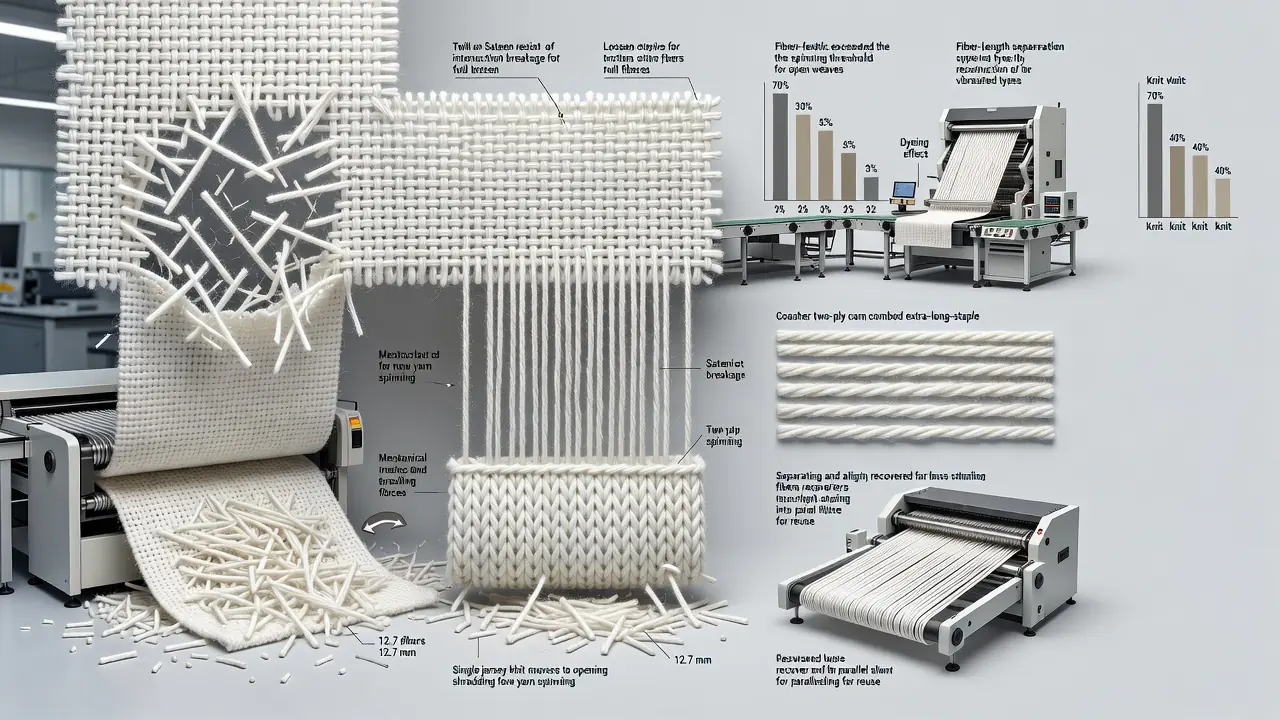
Fabrics with fewer yarn crossings tend to yield longer fibers when they are mechanically recycled, according to a University of Leeds study. The findings suggest that how a fabric is built can influence whether its recovered fiber is useful for spinning new yarn, and that the same knowledge could help sort textile waste more effectively.
Why fiber length matters in recycling
Mechanical recycling tears textiles apart to recover their individual fibers. That process can also break those fibers into shorter pieces, which weakens their value for yarn production. The Leeds researchers used a length of 12.7 millimeters as a threshold for judging whether recovered fibers might be suitable for staple yarn spinning.
What the laboratory tests showed
The team, led by Sophie Rotheram, Abdul Jabbar and Muhammad Tausif of the Leeds Institute of Textiles and Colour, produced 13 fabrics from virgin cotton. Twelve were woven and one was a single jersey knit, and none had been dyed or finished. The samples were run through a laboratory shredder three times under constant settings, then carded to separate the fibers before their lengths were measured.
Across the woven samples, fewer yarn interlacing points were strongly linked to more complete fabric opening. Twill and sateen structures also produced a smaller share of short fibers than plain weave. The researchers attributed these differences to the friction and resistance created where yarns cross. Coarser yarns, two-ply and combed yarns, and extra-long-staple cotton also improved recovered fiber length in the tests. Up to 70 percent of the recovered fiber mass from the more open woven fabrics stayed longer than the 12.7-millimeter threshold.
Where the results have limits
The single jersey knit behaved differently. Its looped structure resisted opening and produced the shortest fibers in the study, with about 60 percent of its output falling below the spinning threshold. That result applies only to the knit and processing conditions tested, and the study did not examine other knit types such as rib or interlock.
The researchers also cautioned that the samples were new, untreated cotton. Dyeing, finishing, wear and laundering can change how fabric responds to shredding, so the results cannot be applied directly to commercial textile waste without further work.
What could come next
The team proposed automated systems that sort textile waste by fabric construction and yarn-crossing density. It also called for industrial equipment that can separate recovered fibers by length, which would help recyclers match material to different spinning methods. Designers and sorters could eventually use the same construction data, though the study itself focused on laboratory evidence rather than production-scale testing.