
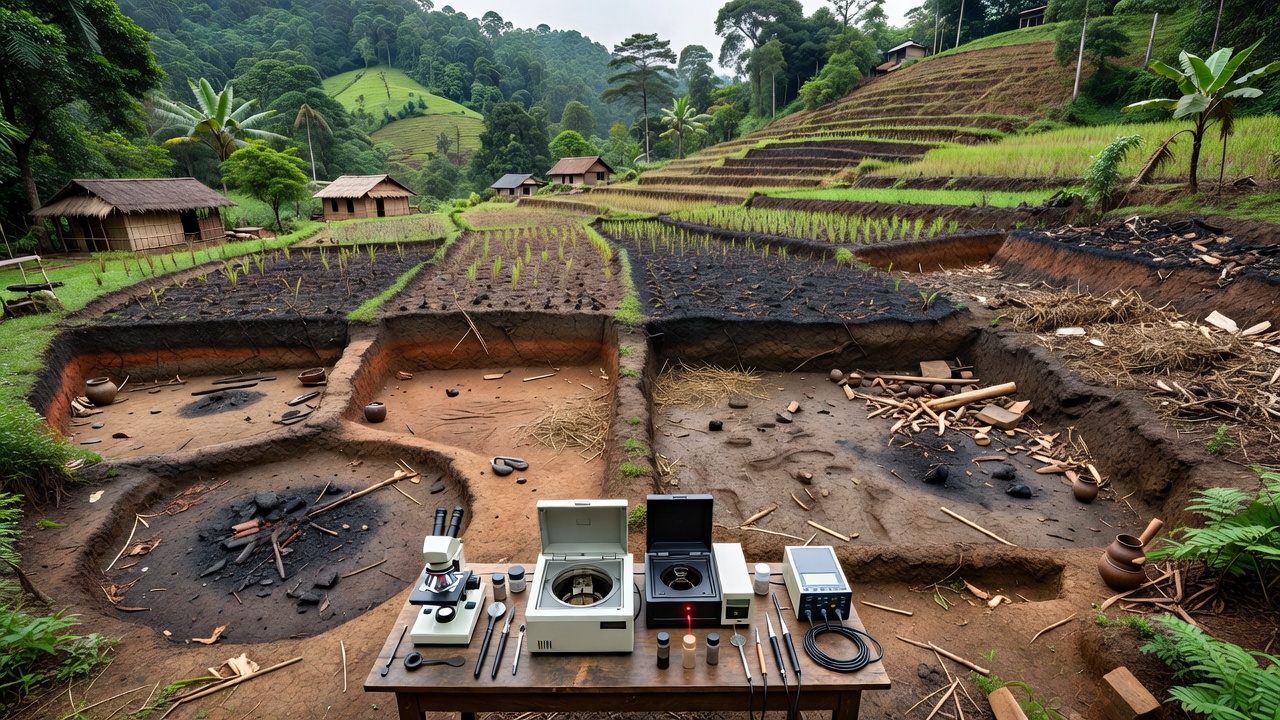
Cooking over a wood fire, sweeping a floor, raising pigs and clearing a field all leave marks in the ground. A study of four villages in India's Garo Hills, published in the journal Ethnoarchaeology, shows that these ordinary activities produce soil signatures that may help archaeologists interpret how people once lived on the same kinds of sites.
How Daily Activity Changes the Ground
The research, led by Rohit and Sukanya Sharma of the Department of Humanities and Social Sciences at the Indian Institute of Technology Guwahati, examined soil in four villages: Duragre, Tebronggre, Misimagre and Gondenggre. The team sampled areas used for living, food preparation, cultivation, animal rearing, wood carving and waste disposal. Their approach, called ethnogeoarchaeology, studies how present-day human activity alters soil so that researchers can recognize similar evidence at ancient sites.
The soils carried different signatures depending on what happened in each space. The study reported:
- Kitchen areas: charcoal fragments, ash and other residues from cooking over wood fires, along with chemical and mineral compounds linked to burning and food preparation.
- Living areas: earthen floors that had been deliberately prepared with clay mixed with bark, stems and straw, and microscopic fragments embedded through trampling, even in spaces that were swept regularly.
- Pig-rearing area in Misimagre: mineral and elemental signatures associated with animal movement, feeding, waste deposition and damp conditions.
- Wood-carving workshop in Tebronggre: wood fragments, charcoal and decomposed plant material, plus chemical signs of organic plant matter.
Swidden Fields and Household Waste
The team also studied swidden cultivation, known locally as A.ba. In this system, vegetation is cleared and burned, crops are grown for a limited period, and the land is then left fallow to regenerate. The researchers found charred plant fragments, charcoal and soil changes consistent with burning, along with elevated magnetic susceptibility. That property can increase when heat alters certain iron-bearing minerals, which makes it a useful marker of past fire.
The study notes that these fields are generally cropped for about three years. Fallow periods were reportedly 10 to 15 years in the past but have shortened to roughly two to five years in recent times, largely because of population pressure. At a household waste area in Gondenggre, the team found charcoal, plant residues, organic matter and mineral changes. Daily sweeping and water runoff on the sloping ground had also shaped how materials were deposited and moved.
Why the Findings Matter, and Their Limits
The practical value lies in what this suggests for archaeology. Stone tools and handmade pottery have already been recovered from the Garo Hills, and comparing those sites with the soil patterns of present-day activities could help researchers infer how earlier communities used particular spaces for cooking, farming and craft work. The researchers used several laboratory methods, including soil thin-section microscopy, X-ray diffraction, infrared spectroscopy, elemental analysis and magnetic susceptibility measurements, to separate human-caused changes from natural soil features.
The authors describe the work as preliminary. It covered a limited number of activity areas and a small set of samples, partly because the villages were actively occupied and sampling had to respect local permissions and cultural considerations. The region's humid climate, heavy rainfall, acidic soils and dense vegetation can also break down organic remains, shift minerals and move soil, which makes human signals harder to separate from natural processes. The authors suggest that a larger reference database of soil signatures, built from more sampling, could become a useful comparison tool for archaeologists working in the Garo Hills and in other areas with similar conditions.