
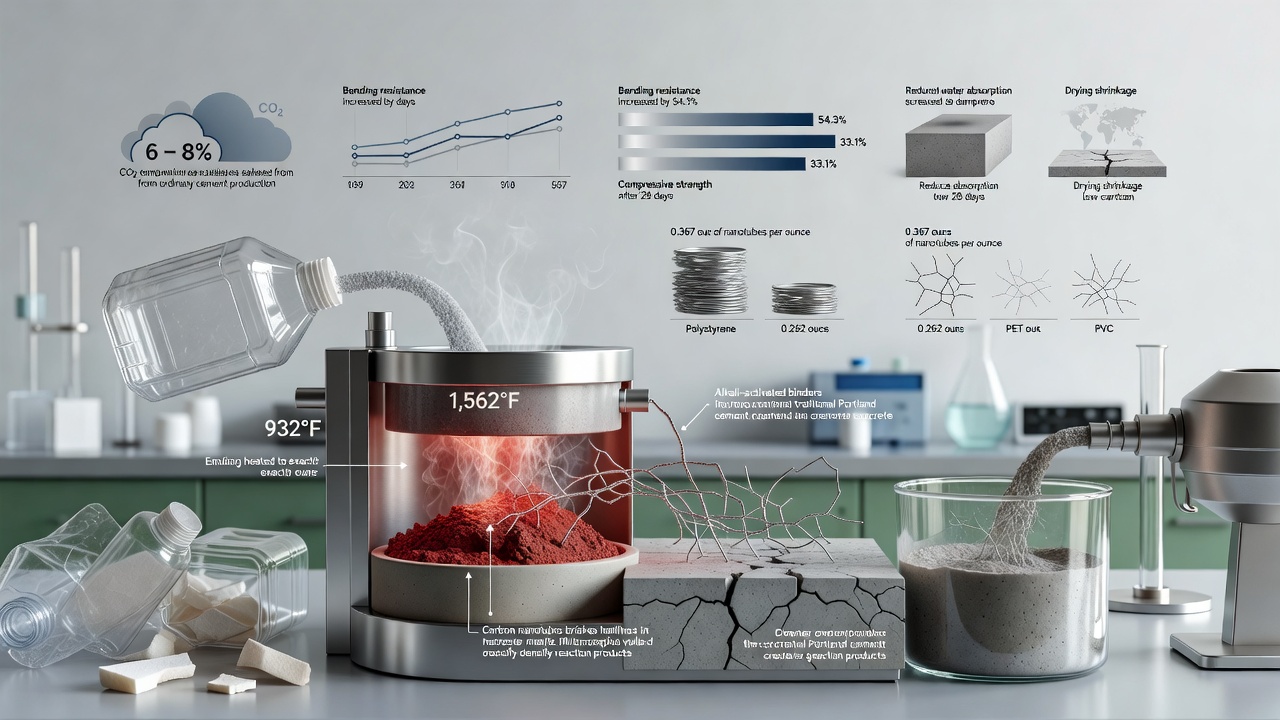
Scientists at Zhejiang University have combined two industrial wastes to create microscopic carbon nanotubes that strengthen a low-carbon construction material. In laboratory tests, the reinforced composite resisted bending 54.3% better than the base material, according to a report summarized by The Debrief and a study published in Nature Communications.
How the process works
The method starts with plastic waste and red mud, a highly alkaline residue left over from aluminum production. The team heated plastic to about 932 degrees Fahrenheit, which broke it into smaller chemical compounds. Those compounds then passed over red mud at about 1,562 degrees Fahrenheit. Iron compounds in the residue helped convert the plastic's carbon into carbon nanotubes while producing hydrogen-rich gas.
Because the nanotubes remain attached to the red mud, the resulting composite can be used without an expensive purification step. That detail matters for cost, since purifying nanotubes is one of the main obstacles to using them at scale.
Why it matters for cement
According to The Debrief, producing ordinary Portland cement accounts for roughly 6% to 8% of global carbon dioxide emissions. Alkali-activated binders, which use industrial byproducts instead of traditional cement ingredients, can lower that footprint. However, these binders tend to become brittle, shrink and develop microscopic fractures.
In the Zhejiang team's tests, the nanotubes bridged small cracks, filled tiny voids and helped produce denser reaction products. Adding 1% nanotubes by weight raised compressive strength by 33.1% after a 28-day curing period. Durability tests also showed lower water absorption and drying shrinkage, which suggests the material may better resist some forms of deterioration. Higher nanotube amounts caused clustering that weakened the effect.
Which plastics worked best
- Polystyrene yielded about 0.367 ounces of nanotubes per ounce of plastic, though with weaker structural quality.
- Polyethylene yielded about 0.262 ounces per ounce under optimized conditions.
- A discarded polyethylene detergent container still produced about 0.206 ounces per ounce despite additives and impurities.
- PET bottle plastic yielded only about 0.009 ounces per ounce, and PVC disrupted the process, so feedstock selection matters.
The researchers estimated that producing this waste-derived additive could cut emissions by 65.8%, reduce energy use by 71.1% and lower manufacturing costs by 13.6% compared with conventional nanotube production. These are laboratory and modeled figures, not results from commercial plants, and the researchers noted that high-quality nanotubes and conventional production still carry significant cost and energy burdens.